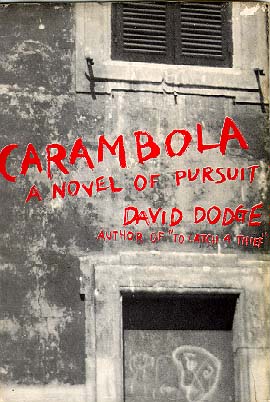
Publishing History
- Boston; Toronto: Little, Brown and Company, 1961
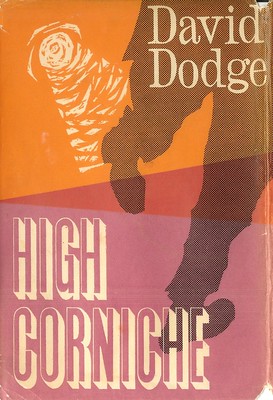
- As High Corniche London: Michael Joseph, 1961
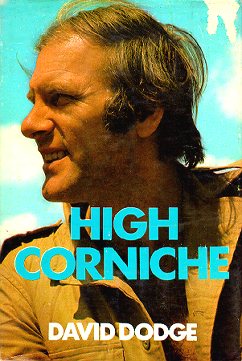
- As High Corniche London; New York: White Lion Publishers, 1972 ISBN: 0856177059
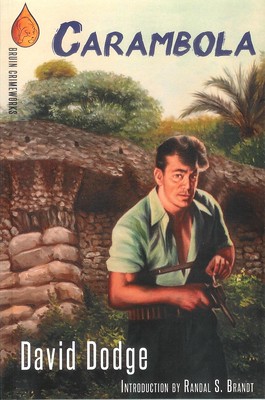
- Eugene, Or.: Bruin Books, 2016 (Bruin Crimeworks); ISBN: 978-0988306288
Setting
- Cannes, Barcelona, Andorra, The Pyrenees
Summary
The story begins on a beach in Cannes, France, when Andy Holland, an itinerant mining engineer, recognizes one of the bikini-clad contestants in a beauty contest even though he has never seen her before. The nearly 18-year-old American girl, who introduces herself as Mike (short for Micaela) Magill, is the spitting image of Holland’s ex-wife, Marsha, who had left him in the middle of a Peruvian jungle a little more than 18 years previously. As a novice engineer engaged in his first contract, he — as Marsha put it — chose a gravel bar over her. Realizing that the girl must be his daughter, Holland soon tracks down Marsha herself. He then learns that Marsha’s husband, Harry Magill — the only father Micaela has ever known — is in hiding in Barcelona, where he is wanted on a charge of murder. Magill had avenged his wife’s honor by shooting the man who’d raped her.
Holland also learns that an egotistical, but well-connected, Spanish marqués, Carlos de Vilasar, has committed himself to helping Magill. The price of his help, though, is Micaela’s hand in marriage. Marsha is torn between her own desperation over her husband’s fate and the prospect of giving her young daughter to a man who neither loves nor respects her, and who routinely risks his own life and the lives of others in the pursuit of reckless thrills. To keep his daughter from a disastrous marriage, Holland agrees to go to Barcelona and find some way to get Magill out of Spain himself.
Holland finds Magill hiding in a barrio with a fiercely loyal Catalan smuggler called Candelas and the oddly assorted trio strikes out overland through the tiny country of Andorra, high in the Pyrenees on the Spanish-French border. Andorra is a smuggler’s haven and Candelas has useful connections there, including a wealthy baron — a “master among contrabandists” — who lives in a 15th-century castle and offers them food and shelter. After leaving Andorra loaded down with packs of illegal goods (anyone not carrying contraband out of the country would immediately attract the suspicion of the authorities) they have to make a difficult night-time climb over a rugged mountain pass.
Apropos of its subtitle, “A Novel of Pursuit,” Carambola is a classic example of the chase novel. As Holland, Magill, and Candelas attempt to reach France, they are being pursued from both sides of the border by the Spanish police, the French customs guards, and by Carlos, who has put up a huge reward for their capture. Throughout the journey, Holland has to deal with his hatred for Magill and his desire that he be out of the way, giving Andy a second chance with Marsha and a first chance with his daughter. These feelings are pitted against Candelas’ threat that anything that happens to Magill along the way will also happen to Andy — at Candelas’ hands.
In the passage that gives the book its British title, High Corniche, Holland and Candelas are attempting to get Magill, an acrophobiac, across a narrow cliff ledge in the middle of the night. Candelas has gone across and Holland is supposed to hand Magill over to him on the other side:
Afterward he could not remember making a conscious decision. There was no time for the kind of choice that could be reasoned. Between one small movement when he had slack to give and the next, when he had not, in the interval it took Magill to shift his weight from foot to foot and reach the end of their joint tether, there was only time to release what he was free to release, the anchorage, and shift his own balance to continue the illusion of security that held Magill from his illusion of danger. He did not know how much further he could carry the illusion. Part of another foot of Magill’s progress, perhaps. He would have to follow him out on the traverse then, or be overbalanced. After that it would depend on Magill; forward, backward, or down, according to his own reaction to the consciousness of insecurity.
Palm and cheek pressed to the cold dampness of the cliff, clinging to it and vanishing balance with the pores of his skin, he thought, Am I afraid? He decided that he was not. In the faith of insh’allah, fear was pointless. It was all decided for you ahead of time. Take care of both her fathers. (Chapter 8)
 A David Dodge Companion