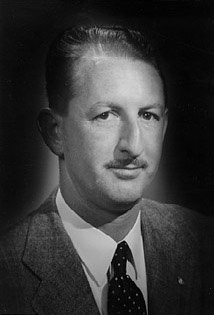
David Francis Dodge was born on August 18, 1910 in Berkeley, California. He was the youngest child of George Andrew Dodge, a San Francisco architect, and Maude Ellingwood Bennett Dodge. Following George’s death in an automobile accident, Maude “Monnie” Dodge moved the family (David and his three older sisters, Kathryn, Frances, and Marion) to Southern California, where David attended Lincoln High School in Los Angeles but did not graduate.
At the age of sixteen, he took a job as a messenger at Citizens National Trust & Savings Bank of Los Angeles and began night school classes at the American Institute of Banking. In 1931, after moving up to the position of supervising the bank’s commercial books, he quit the bank to become a marine fireman on a South American run for the Grace Steamship Company. In 1933, he came ashore to work as a stevedore and night watchman for Tubbs Cordage Company in San Francisco. In 1934, he went to work for the San Francisco accounting firm of McLaren, Goode & Co., becoming a Certified Public Accountant in 1937.
On July 17, 1936, he was married to Elva Keith, a former Macmillan Company editorial representative, and their only daughter, Kendal, was born in 1940. After the attack on Pearl Harbor he joined the U.S. Naval Reserve and earned his first commission in October 1942 in the Office of Supervisory Cost Inspector, 12th Naval District, San Francisco. He emerged three years later with the rank of Lieutenant Commander.
David Dodge’s first experience as a writer came through his involvement with the Macondray Lane Players, a group of amateur playwrights, producers, and actors whose goal was to create a theater purely for pleasure. The group was founded by George Henry Burkhardt (Dodge’s future brother-in-law) and performed exclusively at Macondria, a little theater located in the basement of Burkhardt’s house at 56 Macondray Lane on San Francisco’s Russian Hill. Macondria was home to 120 premieres of original plays in its ten years of existence, including a one-act play called “Propaganda Preferred,” which debuted on the Macondria stage in March 1934 and marked the beginning of David Dodge’s writing career. His publishing career began in 1936 when he won First Prize in the Northern California Drama Association’s Third Annual One Act Play Tournament. The prize-winning play, “A Certain Man Had Two Sons,” was subsequently published by the Banner Play Bureau, of San Francisco. Another Dodge play, “Christmas Eve at the Mermaid,” co-written by Loyall McLaren (his boss at McLaren, Goode & Co.), was performed as the Bohemian Club’s Christmas play of 1940, and again in 1959. In 1961 the Grabhorn Press published the play in a volume entitled Shakespeare in Bohemia.
His career as a writer really began, however, when he made a bet with his wife that he could write a better mystery novel than the ones they were reading during a rainy family vacation. He drew on his professional experience as a Certified Public Accountant and wrote his first novel, which featured a San Francisco tax expert and reluctant detective named James “Whit” Whitney and was titled — perhaps inevitably — Death and Taxes. When it was published in 1941, David won five dollars from Elva and three more Whitney novels appeared over the next five years.
After the attack on Pearl Harbor, Dodge joined the US Naval Reserve and earned his first commission in October 1942 in the Office of the Supervisory Cost Inspector, 12th Naval District, San Francisco. He emerged three years later with the rank of Lieutenant Commander. Following his discharge, having grown tired of holding down a desk job during the day and writing at night, David Dodge packed his wife Elva and five-year-old daughter Kendal into the family car and headed south for Guatemala via the Pan American Highway through Mexico.
This move precipitated the start of not only Dodge’s second detective series, featuring Al Colby, an expatriate private investigator and tough-guy adventurer based in Latin America, but also his second career as an inveterate world traveler — a career he successfully combined with his job as a writer and turned into a string of self-deprecating humorous travel books that chronicle the Dodge family’s journeys and (mis)adventures in foreign lands. His first “travel diary,” How Green Was My Father, was published in 1947 and marked his first appearance on the New York Times bestseller list.
In 1950, the Dodge family landed on the glittering Côte d’Azur, in the south of France, where they rented a villa at just about the same time that a daring and acrobatic cat burglar appeared on the scene, stealing jewels from the rich and famous. When the thief struck at the villa next door, Dodge, who was briefly suspected of being the culprit himself, saw the basis for a story that was “so much stranger than truth that it cried out to be immortalized between hard covers.” The ensuing novel, To Catch a Thief, he claimed, practically wrote itself and was “the easiest eighty thousand words ever put together.”
With the success of To Catch a Thief, which was adapted into the classic film of the same name by Alfred Hitchcock with Cary Grant and Grace Kelly in the starring roles, Dodge abandoned series fiction and shifted his focus in the next decade from detective mysteries to taut international suspense thrillers in which ordinary American protagonists are thrust into extraordinary situations in foreign locales. His later books consistently garnered favorable reviews and sold well enough that he and Elva could keep traveling and living abroad (with the exception of four years spent in Princeton, New Jersey while Kendal was in high school).
Ever the accountant, a recurring theme of Dodge’s travel books is his attempts to extract the last drop of value out of every dollar — or peso or franc or drachma, as the case may be. A self-described “nickel-nurser” and “skinflint,” his most successful book was called The Poor Man’s Guide to Europe, which was published in 1953, spent fifteen weeks on the bestseller list, and appeared in annual revised editions through 1959. The Dodges’ travel budget was supplemented by a steady stream of articles written for Holiday magazine and a deal with Pan American Airways that provided them with free airfare.
In 1968, the Dodges returned to Mexico — the scene of their first adventures on the road — and finally settled down in San Miguel de Allende. A practical guidebook to Mexico, timed to take advantage of the upcoming Olympic Games in Mexico City, soon followed. Dodge returned both to series fiction and plots revolving around financial intrigue with two novels featuring a US Treasury Department special agent named John Abraham Lincoln. However, declining sales and failing health — both Elva’s and his own — led to his final novel, The Last Match, remaining unpublished at his death. The manuscript languished until 2006, when Hard Case Crime resurrected it.
Elva died on October 17, 1973. David died less than a year later on August 8, 1974. They are both buried in San Miguel de Allende.
 A David Dodge Companion